sound art

Deep Fake Birdsong by kelly heaton

In this casual first recording session, Kelly Heaton presents her analog electronic songbird to software engineer Johann Diedrick. Two minutes of audio were recorded from the electronic songbird and analyzed using Diedrick's Flights of Fancy software system to determine whether AI detects actual species of birds. Four bird species of birds were identified by the software with a percent confidence match range of 48% - 96%.

First causal recording session with Johann Diedrick in which he records my analog electronic songbird and analyzes it with his Flights of Fancy (AI) software to identify bird species. To read more, visit: https://www.kellyheatonstudio.com/deep-fake-birdsong-4

Patch Bird by kelly heaton

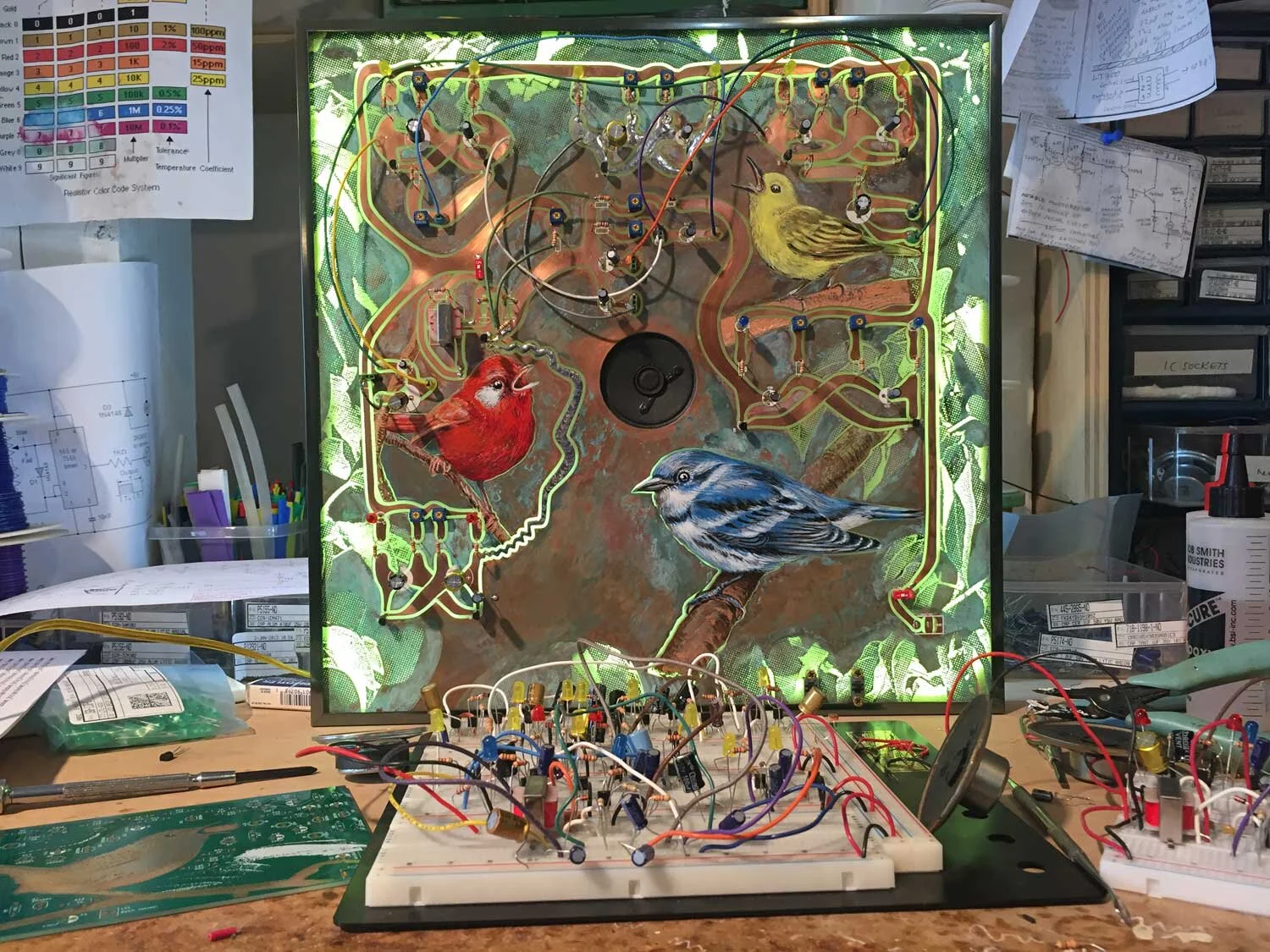
A new circuit board edition titled “Patch Bird,” 2019. Analog electronics, copper etching, patina, and acrylic on fiberglass panel. The image on the right shows the backlighting turned on.

Night birds in a PCB by kelly heaton

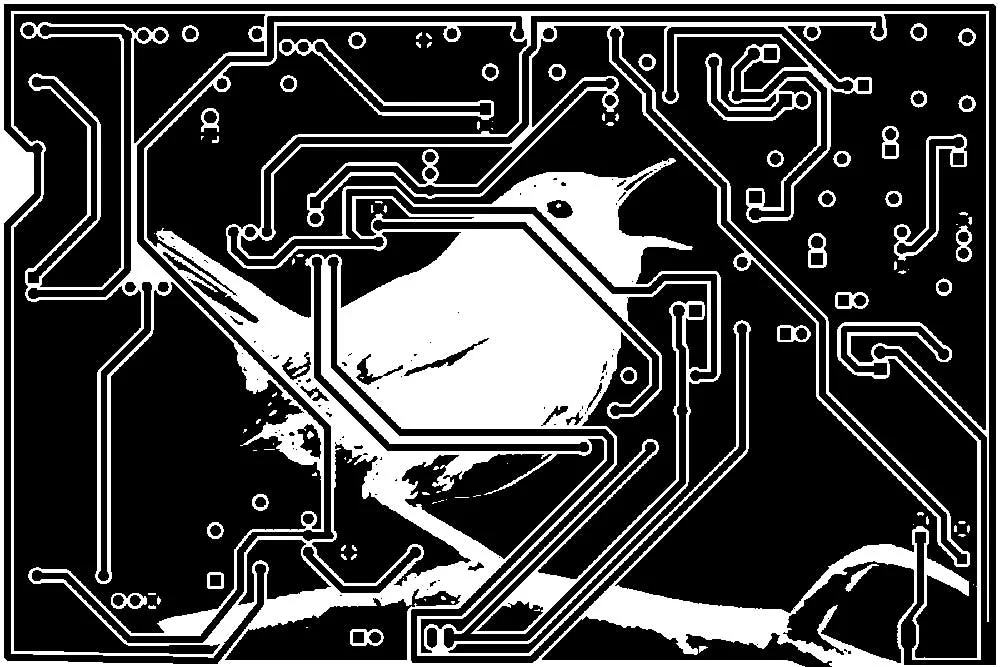
Screen shots from a PCB that I’m designing — an analog electronic bird song generator with a primitive interface for adjusting the song, aka “patch bird.”

Pretty Bird CC test run video by kelly heaton

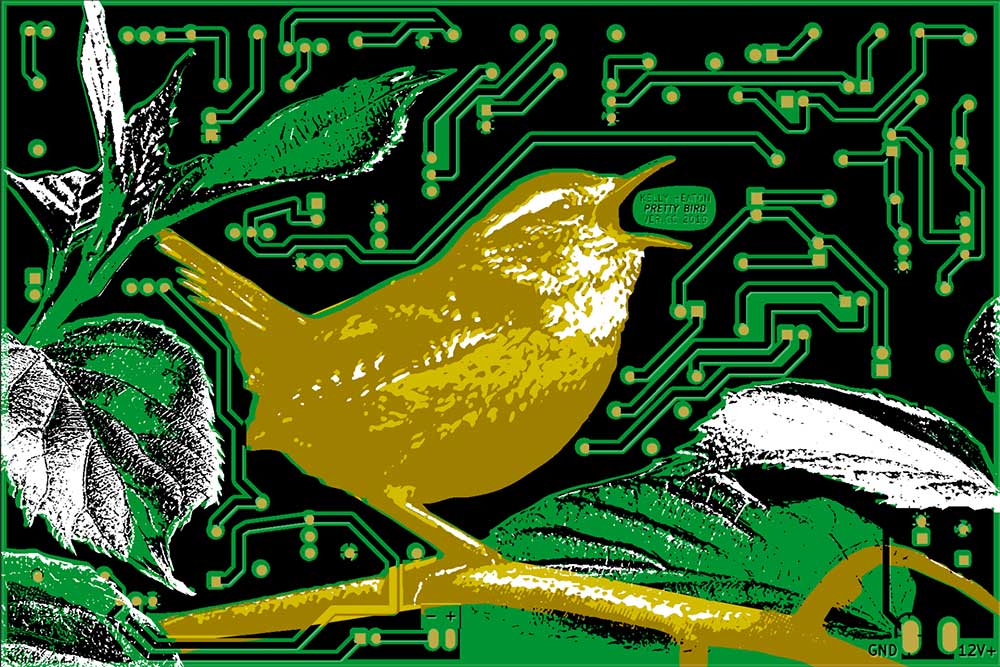
I demonstrate a board from the test run of my "Pretty Bird CC" circuit design. This circuit is comprised of entirely discrete components (transistors, resistors, capacitors, diodes -- no software or recordings). It is powered by 12 volts DC, from which several interconnected oscillators vibrate. The resulting waveforms sound like a chirping bird through an 8 ohm speaker. The green LEDs enable you to see the low-frequency oscillations (listen to the sound and watch the lights to gain a sense for how electricity is being transformed in the circuit). I show the circuit's light sensitivity, and also a few ways to "hack" the chirp quality by changing resistor values. It is not necessary to solder these boards with long component leads (as shown), but I like how the electronics have a "forest" aesthetic in which the bird is nestled. The bird is an image drawn on FR4 board in etched copper, which has been electroplated in gold and is surrounded by green solder mask. I designed this circuit and board layout which was then manufactured by PCBWay in Shenzhen, China. 120 of these pretty printed circuit boards will be given away at Creative Capital's 2019 summer retreat in June. Thanks to Creative Capital for funding this development! I intend to create a similar version for sale later this summer. Note that the silkscreen text on the back of the board (which has some errors I have since corrected) points you to a project page that is still under development. Stay tuned for updates.

Pretty bird process by kelly heaton

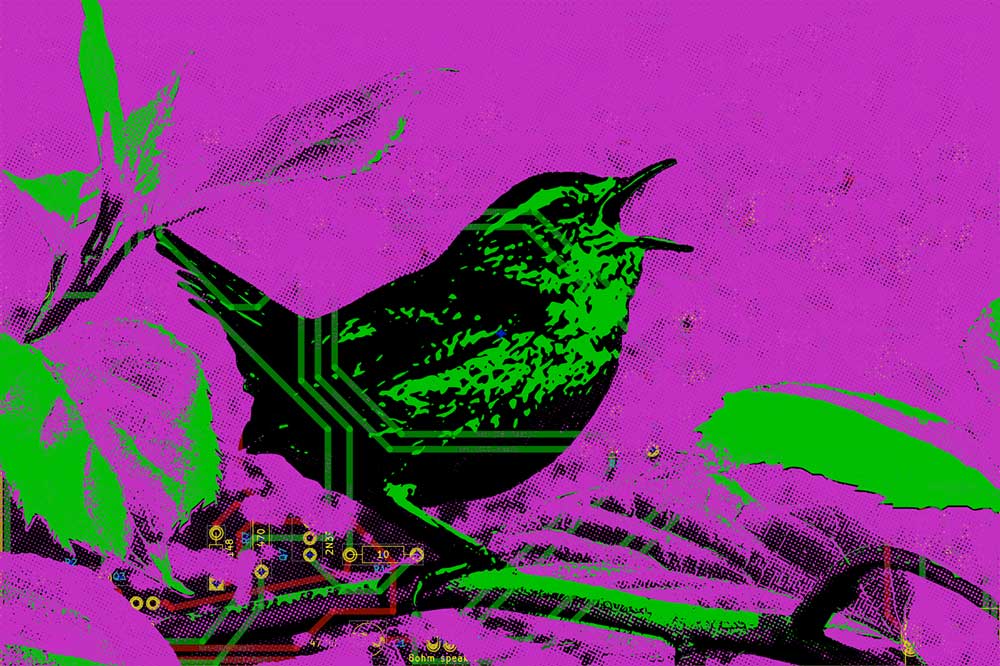
Various images from the process to design a pretty bird printed circuit board for manufacture. April, 2019

Mother Nature Board by kelly heaton

If you’re curious about how I create circuits for my electronic art, check out my new project “Hacking Nature’s Musicians” on Hackaday.io. In a recent entry, I explain how I built a random pulse generator to simulate the natural “timing effects” of Mother Nature conducting a chorus.

https://hackaday.io/project/161443-hacking-natures-musicians/log/153829-mother-nature-board-aka-how-to-conduct-a-natural-chorus

Below (and on Vimeo) is a video overview of the circuit.

This is a companion video to my project "Hacking Nature's Musicians" on Hackaday.io. The video is intended to help you interpret my schematic "Mother Nature Board (random pulse gen).pdf" available for download on my project site: https://hackaday.io/project/161443-hacking-natures-musicians

lesser angle-winged katydid by kelly heaton

lesser-angle-winged-katydid.jpg
The watercolor piece has an embedded analog electronic circuit that intermittently generates the rattle sound of a lesser angle-winged Katydid.I added a couple of electronic crickets to give the sound a natural context.

Watercolor and analog electronic study of a Lesser Angle-winged Katydid, 2018. I plugged in a couple of crickets to give this fellow some natural context. To read more about how I made this, visit my project “Hacking Nature’s Musicians” : https://hackaday.io/project/161443-hacking-natures-musicians