
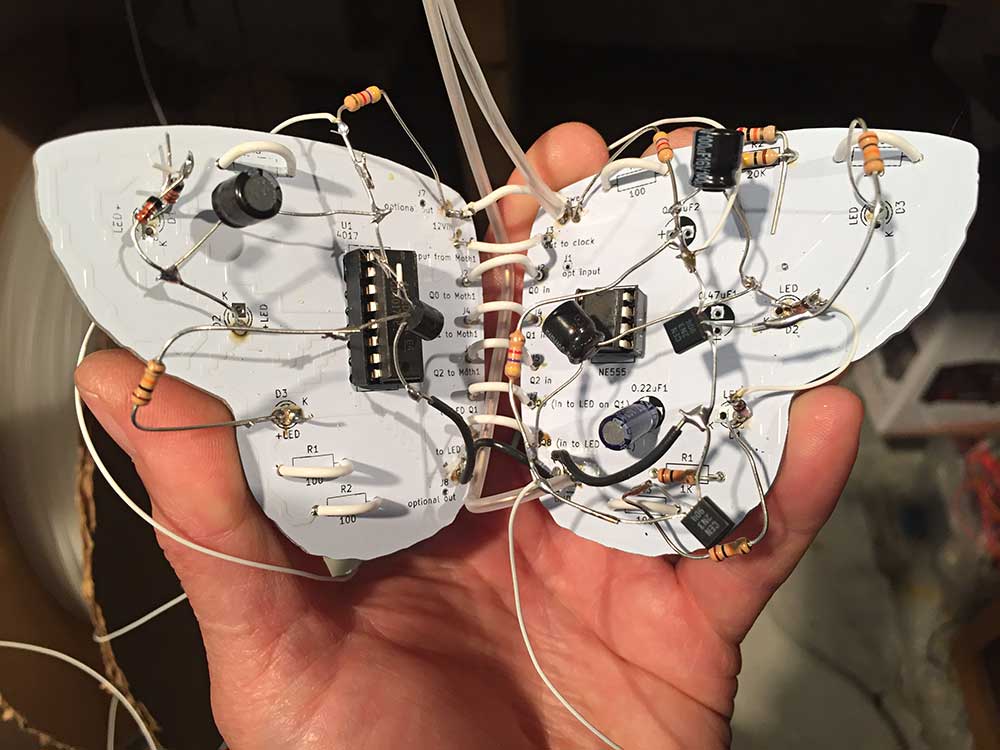

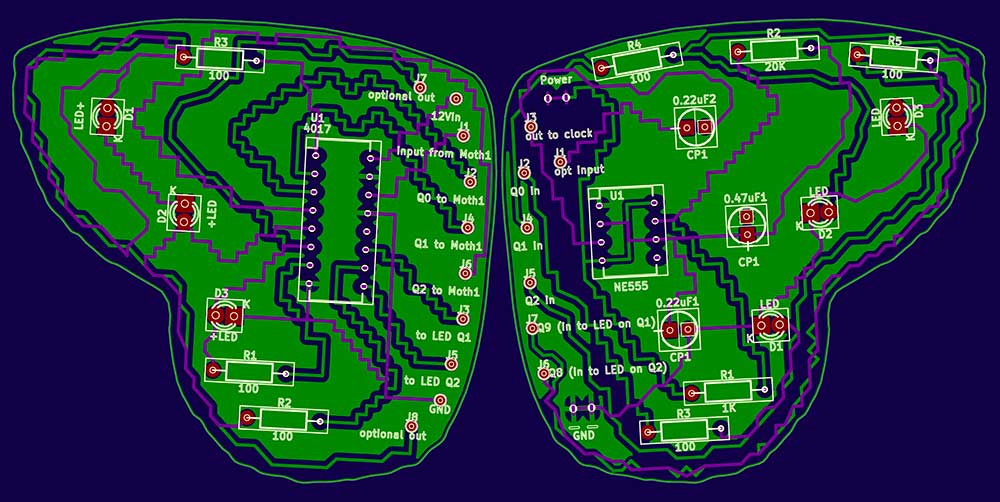
Lately, I've been inspired by the little white butterflies flitting around my garden. I used analog electronics and LEDs to animate their flutter patterns. My circuit contains one master 555 timer / 4017 counter that sequences three butterfly (or moth) circuits. The individuals also have 555 timer / 4017 counter circuits that flash their LEDs in rapid sequence. I used transistor inverters on the master circuit to convert the active high logic of the 4017 to active low; and I connected these signals to clock enable (pin 13) of the 4017s on each of the butterflies. That's what causes their blinking to pause periodically. The random appearance of the blinking is thanks to capacitive coupling between signal lines, and without this the "flutter" effect is pretty boring. In other words, nature contains both order and chaos, where the order is by design (who's design? I have no idea) and the chaos happens through simple, recursive relationships that get complex fast.
Electronic moth assembly /


Making moths at my bench (May, 2018). The wings are dyed velvet that I embroidered with an old CNC machine (a 1982 refurbished Ultramatic at NovaLabs in Reston, VA). The bodies are circuit boards that I designed involving timers, counters, and multivibrators to sequence a trail of LEDs. The legs and antenna are laser cut plastic. The LEDs are multiplexed on a flexible circuit board that I modeled after symbols in the ancient temples of Mitla. All of these boards were manufactured by PCBWay in China. These photos were taken at my studio in Virginia.
Electrolier in progress /
Scenes from my studio (May 24, 2018). Dyed and embroidered velvet moth wings, custom analog electronics, laser cut acrylic, wire sculpture.
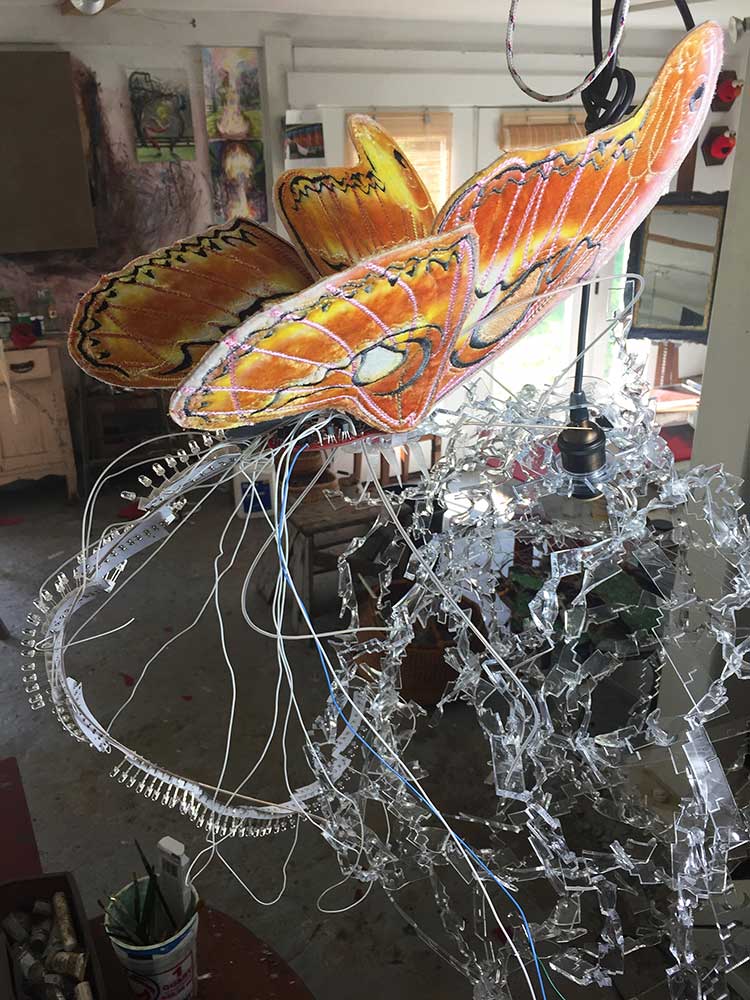

Cecropia moth /
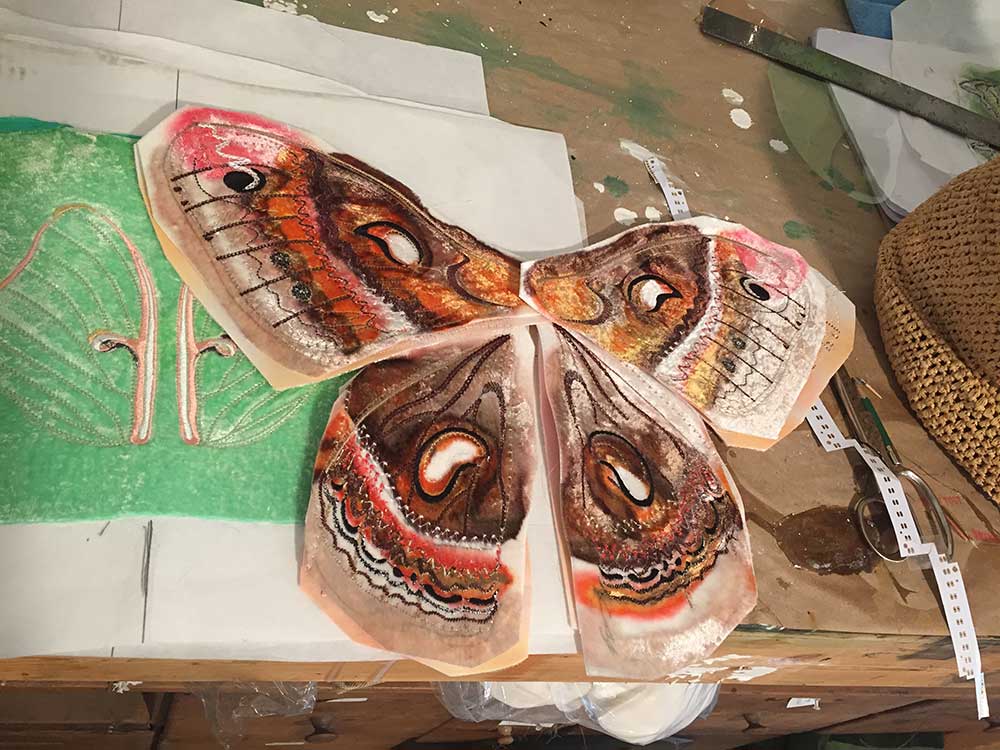
Dyed and embroidered velvet Cecropia moth wings (over a Luna) for a work in progress. 2018
Cedar Sphinx Moth /
I continue to make moth wings for my latest Electrolier sculpture. Here is a Cedar Sphinx Moth with a circuit board body and embroidered velvet wings. Later, I will reveal the function of the circuitry and how the wires relate to the overall sculpture... but for now, pretty wings are what I have to offer.


Anatomy of an obsolete moth /
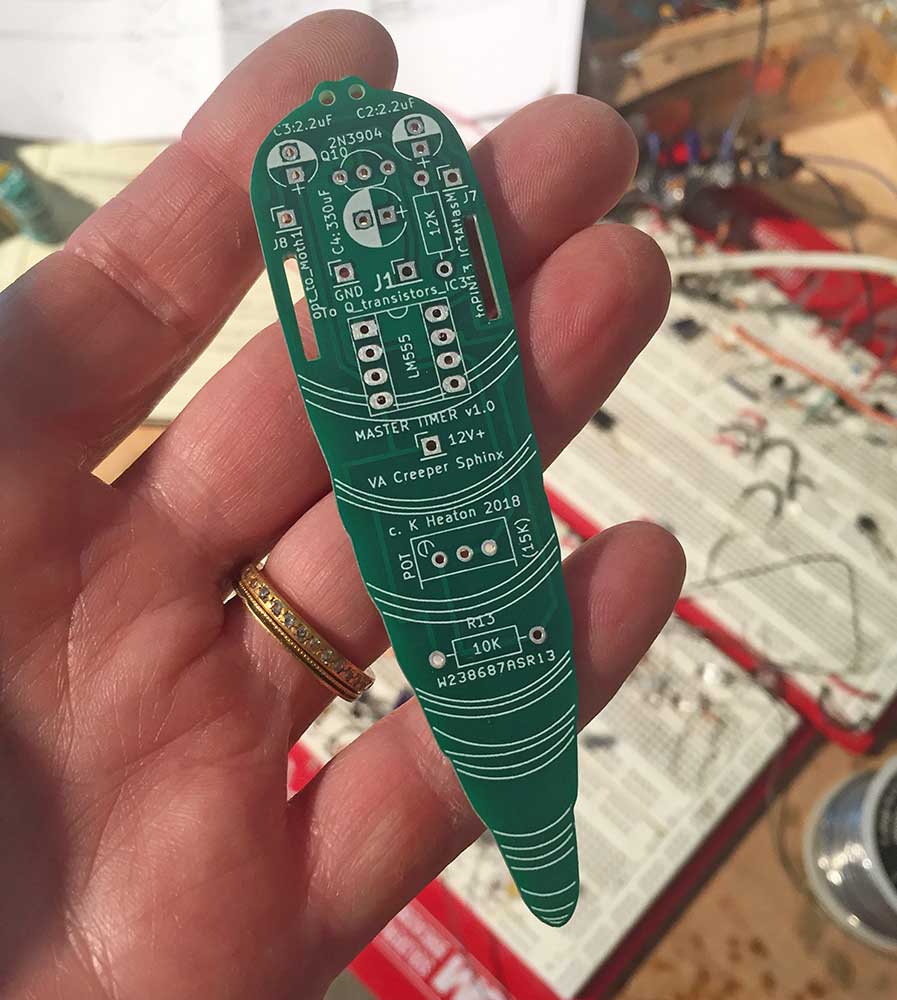
I've spent the past several days heat-bending laser cut acrylic into the shape of moth trails (more on that to come)... and at some point, it occurred to me that I have to redesign all of my electronic animals to accommodate a master controller with a custom remote control. I am fatigued by serious engineering and wanting to make more emotional art, but that might not happen for a while longer. Here is an obsolete moth circuit to express my mood.
Atlas Moth /
Informal studio photos of an Atlas Moth that will fly in my latest Electrolier sculpture.


Low Poly Owl /


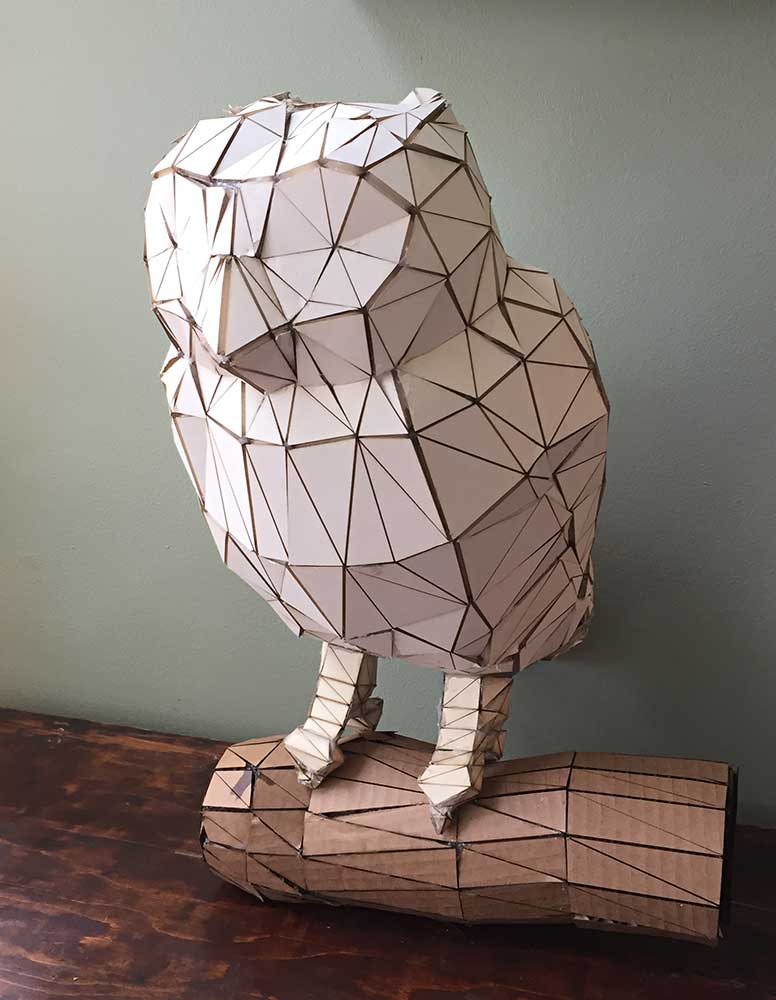


I've been working on a series of "low poly" sculptures for my latest Electrolier sculpture. Here are some images of an owl in progress. He was modeled in Blender, unfolded using a research software from a professor at GMU, cut on a laser cutter at Nova Labs, and assembled in my studio. The owl is still in the process of being refined and painted. The image of the pattern corresponds to the owl's right foot. The reason that my Blender model is separated into parts (body + two feet) is related to the pattern's complexity - it's easier to unfold if I process it in pieces.