

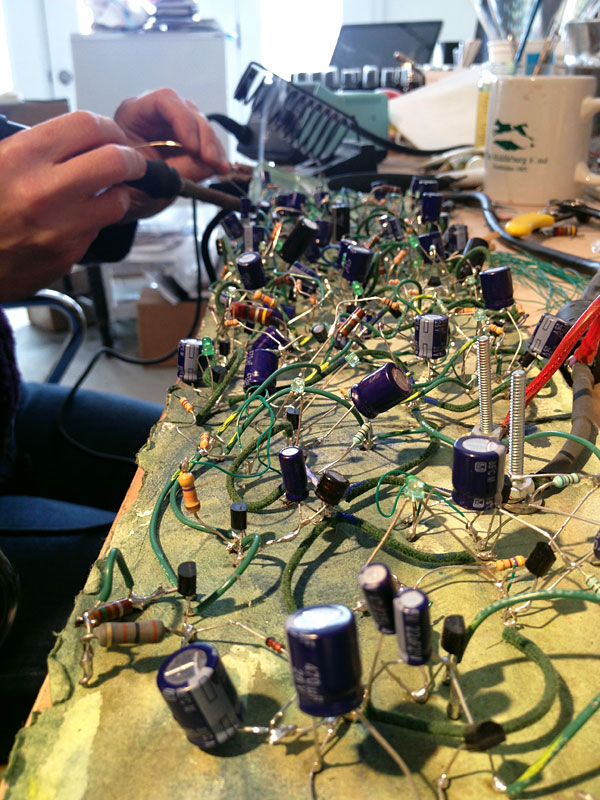


Building the circuit for The Wedding Tree (work-in-progress). Analog electronic components are pegged through heavy watercolor paper and soldered together to drive LEDs and pager motors. Photo credit: Sarah Loy
open studio: brass skep /


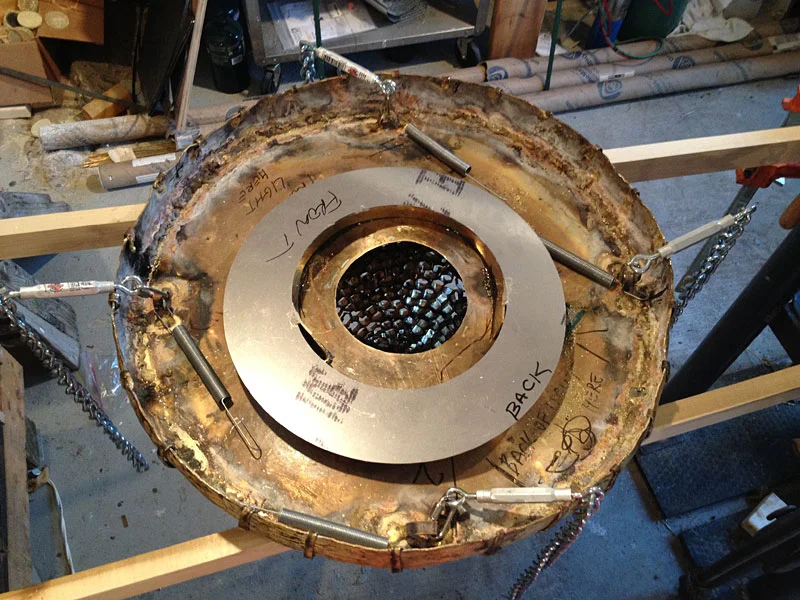
Finishing the brass skep with an oxy-acetylene torch and bronze brazing rods. Surface color was controlled with torch work and a lemon-salt solution; detail was re-introduced with a die grinder. The last image shows a system for hanging the 100 pound sculpture, which will premier at Ronald Feldman Fine Arts in September 2015
open studio: ramayana, 2012 /
Detail of Kelly Heaton's, "Ramayana," 2012. Conductive ink, electronics and gauche on paper. 15" x 15.5" unframed
In Fall 2012, while The Parallel Series was on exhibit in New York, I finished reading the great Hindu epic, "Ramayana." I highly recommend the translation by Ramesh Menon. Menon's two-volume version of the Mahabharata is also excellent.


Conductive ink was used to draw this illustration of Rama in meditation; and also defines resistors for the circuit which illuminates his chakras. Nine volts of electricity flows throughout his figure: 6 volts from the alkaline battery at his base, plus 3 volts from the coin cell at his crown.
The width and length of a line drawn with conductive ink determines resistance: wider and shorter lines give less resistance than do longer and skinnier. Electronic parts, such as transistors and LEDs, are connected to these "ink resistors" with a pressure contact (made possible with tiny bolts).
This work is available for sale through Ronald Feldman Fine Arts in New York, NY
open studio: welding brass skep /


Top row, left to right: making of the traditional bee skep (from Wikipedia); a stack of welded brass rings; brass rings with a ground surface to create straw-like texture; shaping the segments of the brass rings with a peening hammer and wooden cradle
Bottom row, left to right: welding the brass rings together with an oxyacetylene torch and brazing rods; two welded rings with clamps to attach a third; measuring the uppermost ring, which has been hammered to reduce its diameter, in order to create a tapered top for the skep; a bee skep from a french fairytale
open studio: brazing steel torus /


Brazing a custom connector to the center of a steel torus. Kelly Heaton, work-in-progress, September 2014
pollinators: death to drones /
As cold weather approaches, the worker bees (female) expel the drones (male) in preparation for winter. Drones can be identified by their larger eyes that meet in the center, as well as their larger black abdomen. The smaller, active bees are the females working to remove the dead. Bees in this role are known as "undertakers" for the hive. Nearly all of the bees in this video are dead or dying drones on the ground in front of their once nurturing hive. In another month or two, the remaining worker bees will form a tight cluster around the queen, vibrating their wings to keep the colony warm (a remarkable 94 - 98 degrees F in the center); and rationing their honey supply until Spring.
This video also shows signs of hygienic behavior - notice the drone larvae which appear affected by Varroa mites. I am doing a mite count to see if I need to treat this hive.
September 2014 / Clarke County, Virginia
pollinators: (wo)manmade habitat /


Kelly Heaton, images from work in progress, 2014. Fabric, wire, paint & other sculptural media
open studio: perfume /
My perfumer's organ within my studio. Kelly Heaton, July 2014
Breathe in, the wonderful world of smell, and see with your inner eye