
astable multivibrator

Follow me on Hackaday by kelly heaton

I have started a project to describe and share my analog electronic circuits designs so that people can better understand my electronic practice. My project, located on Hackaday.io, is called “Hacking Nature’s Musicians.” You can find it here: https://hackaday.io/project/161443-hacking-natures-musicians

In a recent project log, I describe how I create chirping crickets using discrete transistors. Check it out: https://hackaday.io/project/161443-hacking-natures-musicians/log/153312-crickets-natures-favorite-astable-multivibrator
This video is designed to show you the elements of a cricket's song. In the beginning, you will hear a steady, unbroken ringing. This is created by a transistor astable multivibrator with relatively small capacitor values (both are 2.2 uF in this example). The resulting oscillation goes through a simple high-pass filter and transistor amplifier to a custom 2.8KHz piezo electric speaker (in the background - details available on Hackaday under my project "Hacking Nature's Musicians"). Next, I unplug the base resistor of a transistor in the astable multivibrator (==silence) and connect the base to a signal incoming from another, slower astable multivibrator. The cricket starts to chirp. It's that simple: an astable multivibrator that generates timber connected to an astable multivibrator that controls tempo. Finally, I add a pull-up resistor on the same transistor base just to show you how it affects the sound. Minor adjustments to this design will give you many variations on the theme (crickets with personality).


Electricity is life by kelly heaton

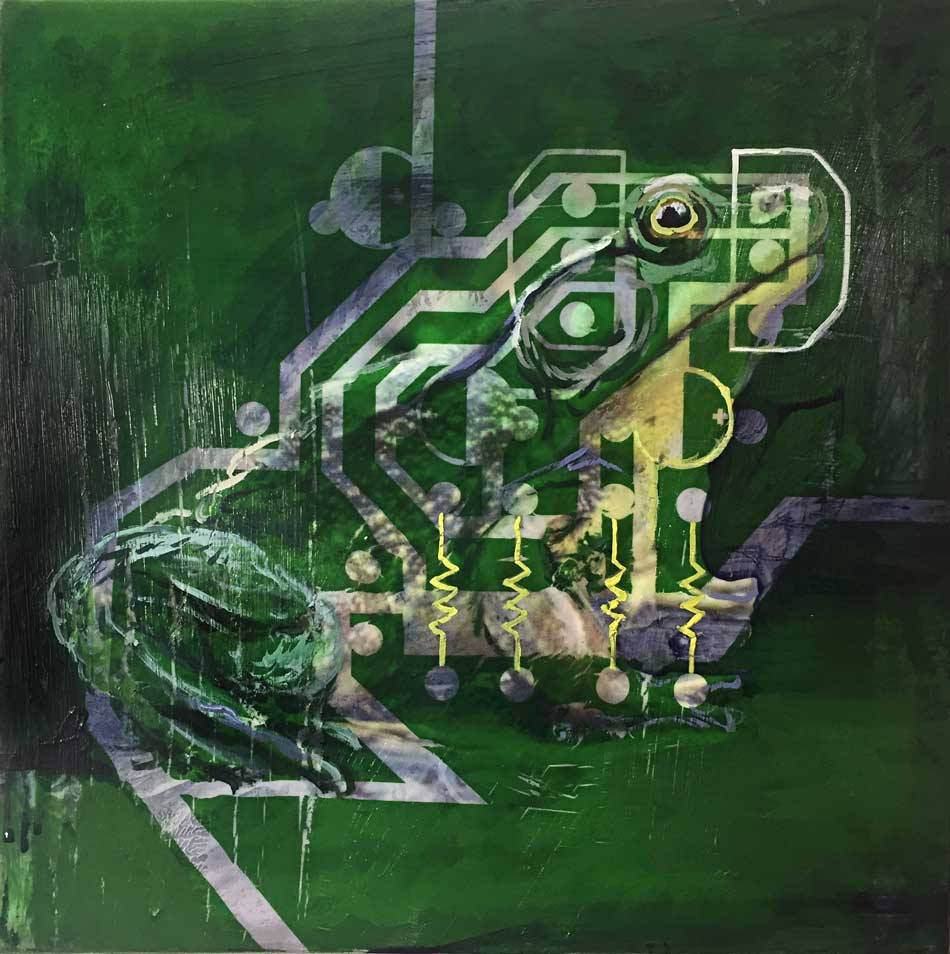
Kelly Heaton circuit PCB frog

I have spent nearly twenty years exploring the world with the eyes of an artist and the curiosity of an electrical engineer. All living creatures are electronic devices. Are all electronic devices living creatures? The distinction between manmade and natural lifeforms is blurry, and growing blurrier every day, as human-made electricity vibrates the architecture of reality itself.

In this painting, a frog is merged with a printed circuit design for an astable multivibrator. This amazing little circuit has profound implications because it takes a static voltage and converts it into an alternating signal. This circuit is one of the ways that I make electricity vibrate -- and not only me; the astable multivibrator is a common element in circuit design. The reason that I like it is because it is simple, inexpensive to build, and easy to understand. I'll be talking more about multivibrators in the coming weeks.

open studio: astable multivibrator drawing series #1 by kelly heaton

Astable multivibrator #1, 2016.  Graphite, watercolor, and ink on paper.  41" x 33." Kelly Heaton

Studio finances are tight these days, so I'm making images of electronics instead of building circuits or sculpting them (both of which I love but cost $).  Here's my first large drawing of an analog astable multivibrator, an oscillating circuit that I use very often.