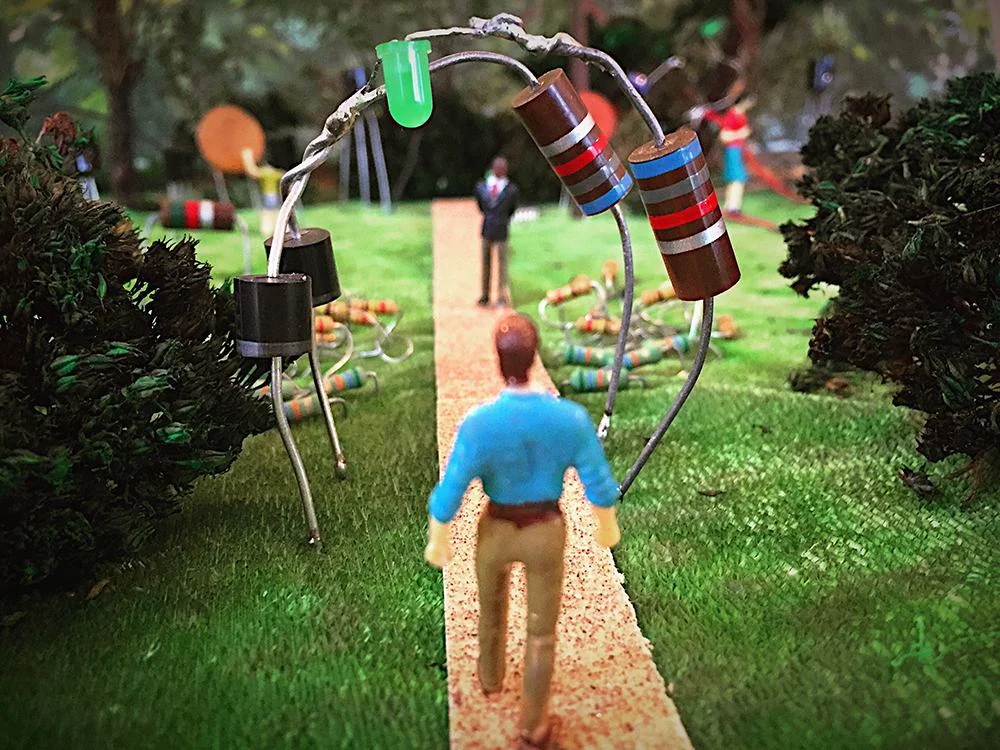
Image description from left to right: (1) Entering the garden through one of four analog logic gates, in this case, the logical AND gate. The colors of the resistors in the gate were chosen in honor of France. (2) A scene with woman and child enjoying the garden. The woman sits on a microprocessor, meanwhile her child plays tries to climb onto a vintage resistor. A transistor and capacitor are in the background. (3) A woman regards a dead microprocessor. In the background, a transistor is being overgrown by a twisting vine. Other electronics have organic, natural forms that make them hard to distinguish from the surrounding vegetation. (4) Detail of a vine overgrowing a transistor in a post-apocalyptic vision of the Electronic Sculpture Garden.
NOTES
I continue to create vignettes of my Electronic Sculpture Garden using miniatures and photography to convey a built environment. Why am I doing this? I want to bridge the consciousness gap between man and machine, to pull back the curtain of Oz, and especially to raise human understanding of the electronics that pervade modern industrialized cultures. Most people are curious about how things work, but are uninterested in a steep learning curve. Understanding electrical engineering is steep indeed. Electronic components are tiny and foreign, like characters in a strange alphabet. Their energy-transforming behaviors are largely invisible, and circuit diagrams are gibberish to the untrained eye. Even well-documented circuitry can be difficult to analyze and comprehend. Thus, electrical engineering is pigeon-holed as geeky, meanwhile people of every generation, gender and nationality are becoming dependent on electricity (==God save us if the grid goes down for any length of time).
Meanwhile we become dependent on manmade electronics, humanity is transforming the natural environment of earth. Nature is truly the pinnacle of sophisticated electronic design: people, like all biological organisms, are energy consuming, transforming and expending machines. One could argue that there’s no real distinction between nature and electronics because both are systems for energy transformation. The real distinction concerns the maker: Man versus God or Nature (or whatever Entity you believe to be the creator of things not made by humans).
Why a garden? People seem to have an easier time relating to things on our same physical scale. Human-scale sculpture of electronic devices situated in a grassy landscape would be a playful and intriguing experience, like concrete dinosaurs in an amusement park. Barriers to understanding (and prejudices against electronics) would -hopefully- be less than usual. The green of a garden can be compared with the green of a classic circuit board, and everyone feels comfortable on a lawn. Situating electronic sculpture within a formal garden is an opportunity to define the landscape in an entirely new way, yet draws upon a centuries-old tradition of gardens with fantastical sculpture. In short, big electronic sculpture in a modern garden is cool.
Another facet of garden design that interests me is the relationship between Man and Nature in the Anthropocene. Here, I have more questions than answers... Electronics transform energy, plants transform energy, but are they both alive? As manmade objects increase in sophistication, will they eventually become as living as natural systems, even competing or merging with nature? What happens when humans stop making electronic things (for example, due to an apocalypse); will "original" or "true" natural reclaim manmade artifacts, eventually composting most or all trace of human ingenuity? I love the idea of vines twisting up the legs of a transistor, or flowers growing within a patch of resistors. The visual effects are beautiful and intriguing, as are the conceptual implications.
I will continue to explore these ideas in the design of my Electronic Sculpture Garden, and I will eventually publish a book with my findings.