
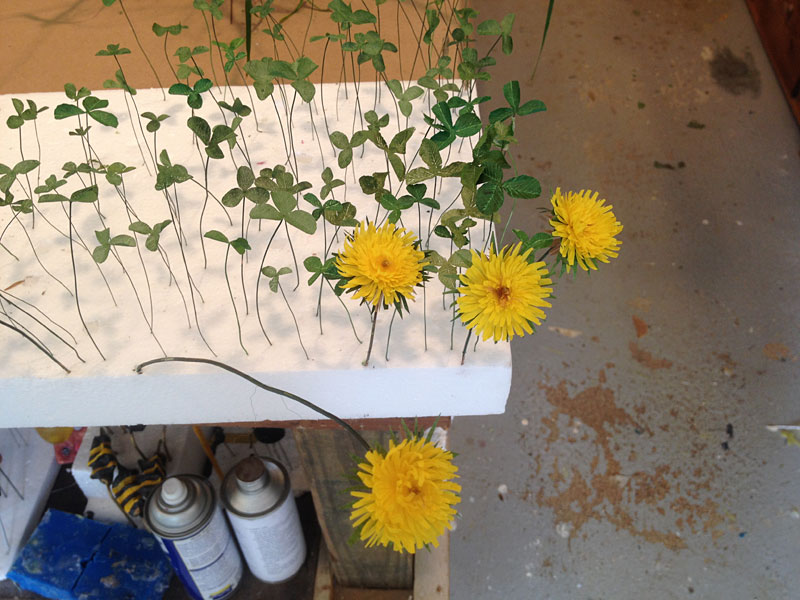


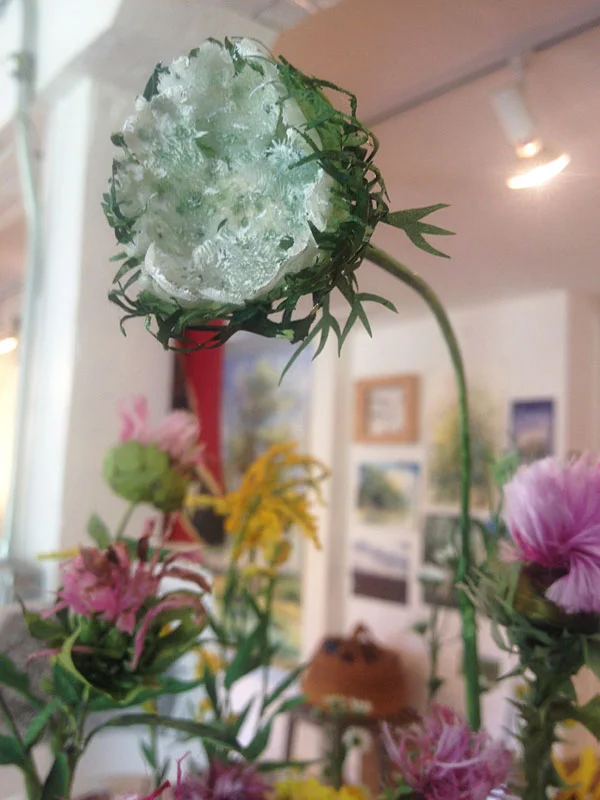

Media: fabric, cloth, wire and paint. Work in progress, Kelly Heaton, 2014
open studio: contact dermatitis /
inspiration: manly p. hall lecture / the third eye /
Pineal Gland & the Endocrine System. Man, Grand Symbol of the Mysteries by Manly P. Hall
pollinators: 1st look into my new hives /
Beehive 1 of 2, started from a nuc of locally raised bees in Spring of 2014. Video was shot in early June 2014 (through the smaller, rear entrance).
The Queen of hive 2 of 2


Various images of frames in my new hives, both 1 and 2. Beautiful!
inspiration: arthur young /
A 56-minute documentary about the life and work of Arthur Young. Contains rare early helicopter footage, interviews with Young and his associates, an illustrated narrative introduction to the Theory of Process and much wit and wisdom. Producer/director: Arthur Bloch Associate producer/camera: Michael Shedlin
wild card: the great stalacpipe organ /
This is the first ever composition for The Great Stalacpipe Organ, the largest musical instrument in the world, located deep in the caverns of Luray, Virginia. The Organ consists of hand-tuned ancient stalactites of varying sizes that are hit with solenoid-actuated rubber mallets. The mallets are controlled by a custom made pipe organ console.
Leland W. Sprinkle designed and implemented the organ during a 3-year period around 1956.
From Wikipedia:
"Two accounts of Sprinkle's conception of the instrument are known. From the discovery of Luray Caverns in 1878 onward, the favorable attributes of the formations for creating musical tones were well known. One of the earliest references to performances of lithophone music in Luray Caverns comes from the tour led by co-discoverer Andrew Campbell for a group sent by the Smithsonian Institution in 1880. According to a summary of the report incorporated into the earliest printed guides to Luray Caverns, Campbell surprised the group by playing a tune on a formation, probably the one that came to be known as the Organ. By the early 20th century, performances of folk tunes, hymns, and other well-known pieces were a regular part of guided tours. According to the modern guided tour, Sprinkle is said to have conceived the idea for the Great Stalacpipe Organ during one of these performances when he toured Luray Caverns on his son's birthday in 1954.
A variation of the story of the instrument's conception is that Sprinkle's son Robert hit his head on a stalactite, producing a tone that inspired Sprinkle to invent the instrument. This account is the one published in a Meccano Magazine article from 1961 and in an article in the 1959 Rosicrucian Digest."
open studio: wedding tree /


Pastel drawing and watercolor painting of the old pear tree, beneath which I married Samuel David Burns in 2010. Kelly Heaton, work-in-progress (2013 - 2014)
spirit world: listen to space /

http://www.nasa.gov/mission_pages/rbsp/news/emfisis-chorus.html
http://www.thehindu.com/sci-tech/science/sound-of-deep-space-revealed-for-first-time/article5360824.ece
The Dawn Chorus: long wave radio signals recorded by the Cluster II satellite (plus an overlay of shamanic drumming). Via artist John Scott
The Sounds of the Universe - Professor Carolin Crawford